

Steel Construction: How is a knife’s steel made?

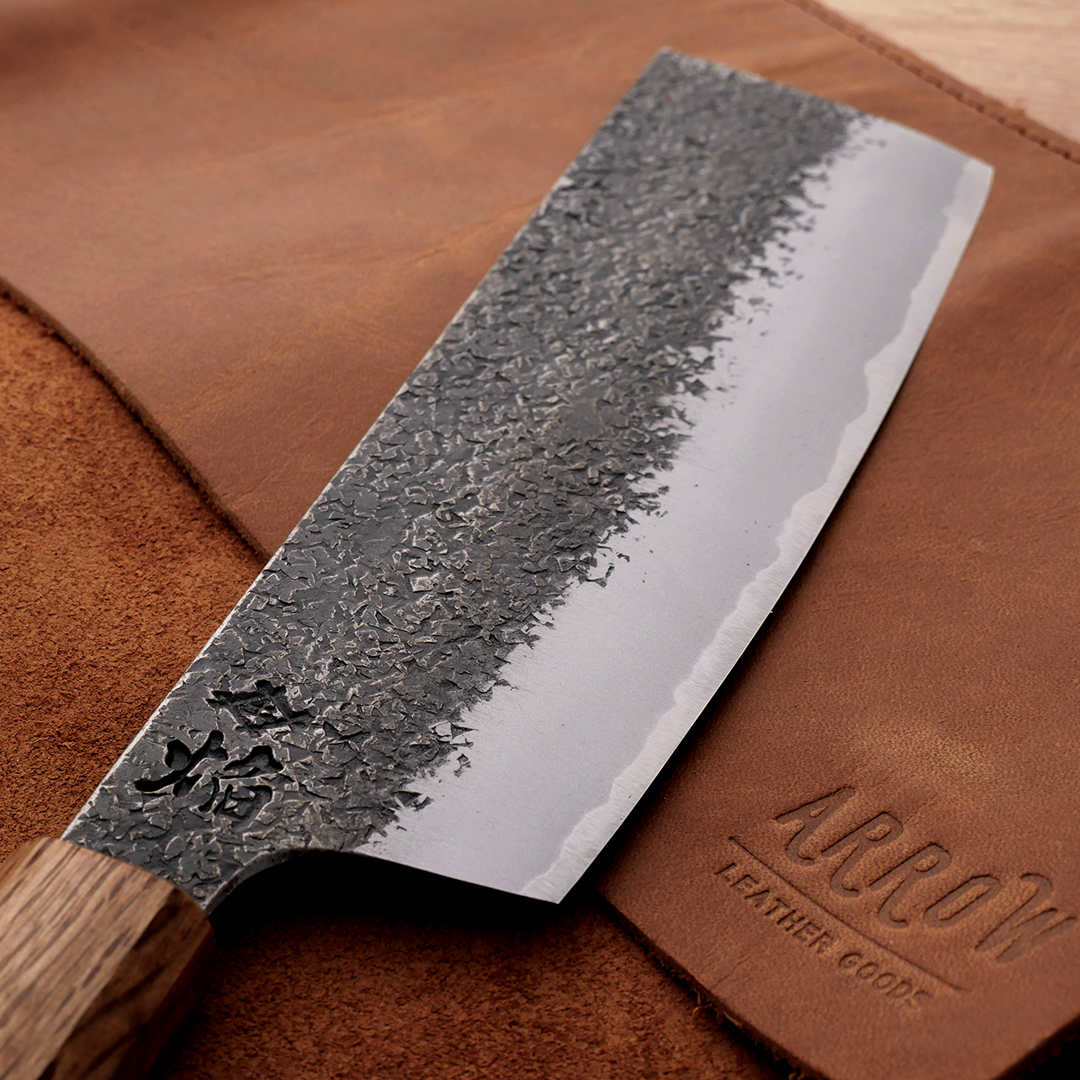
When inspecting a Japanese knife, it is easy to admire the expertise and craftsmanship that goes into producing the blade: the shape, the finish, the grind, the complete product. First, however, it needs a perfectly manufactured piece of steel for all these elements to come to life.
Steel construction is arguably the most critical part of forging. The steel and construction determine the quality of a knife’s cutting performance, degradation, and edge retention. Do you want a sharper blade with longer edge retention that sharpens easily? Let’s go high-carbon. Do you want something easy to maintain but retains a sharp edge? Let’s go carbon cladded in stainless steel. Do you want a workhorse that can take a bit more punishment? Let’s go with a mono stainless steel blade.
Various steel construction techniques are applied to create the abovementioned blades. San Mai, Ni Mai and Monosteel/Honyaki.

San Mai
San Mai loosely translates to “three layers”, eluding to why it always has three layers of steel. The blade is always double-bevelled. The three parts are made of two types of steel—softer steel on the outside with harder, higher-carbon steel wedged on the inside.
Harder steels lead to sharper cutting edges, allowing the blade to hold its edge for extended periods. However, rigid steel, fully exposed, can be brittle and prone to increased oxidisation.
Enter San Mai. San Mai is perfect for having the best of both worlds. The softer outside layer referred to as “cladding”, protects the more rigid core steel. In addition, the outer layers can be made from the same core steel while the core steel, or inside, has added carbon. The most popular combination is probably harder carbon steel cladded with a stainless exterior. This combination protects the core steel from oxidisation, and the softer stainless adds durability to the blade.
Another type of steel construction similar to San Mai is called Warikomi. The main difference between San Mai and Warikomi is that the softer steel wraps around the Hard core steel, covering the spine like a hotdog.
It is vital to bear in mind the effects of San Mai on sharpening a blade. With frequent sharpening at, let’s say, a 15-degree angle, steel from the exposed hardcore edge is removed. As a result, the cutting edge will move closer to the softer cladding over time. Eventually, you would need to push the cladding line up to expose more core steel. If this is not done, you will start cutting on the soft cladding, and your edge will dull quickly. Therefore, if you have a San Mai blade, always look for the cladding line as a guide to sharpening.

Ni Mai
As with San Mai, Ni Mai loosely translates to “two layers”. So yes, this blade is made of two parts which serve the same purpose as San Mai. Only this time, Ni Mai blades are always single-bevelled. The harder, more rigid steel is covered with softer steel on the outside or the face of the blade.
Ni Mai blades are also constructed differently. The blade is only sharpened on one side, with the outer wedge cladded with softer steel limiting oxidisation. The other side has a slight concave finish creating an air pocket when slicing to prohibit produce from sticking to the blade. The concave side is also the exposed, harder core steel and will lead to more oxidisation creating a natural patina.


Monosteel/Honyaki
Monosteel, as the name suggests, are blades made of single steel or “one layer”. Monosteel blades can be single or double-bevelled. The blade is made of the same steel and tempered the same way, from high carbon or softer stainless steel.
The edge retention on a mono-steel blade is OK, but the durability of these blades makes up for that. These blades are also mostly available at a reasonable price. Don’t get us wrong, the edge retention is still way better than the discounted knives at the supermarket, as the blades are produced with quality Japanese steel.
Honyaki is also a form of a mono-steel construction. Honyaki is the oldest forging method, but only 1% of Japanese knives are still produced this way. Honyaki was mainly used to forge Samurai swords.
A single piece of steel is differentially hardened, creating two types of hardnesses on the blade. This is achieved by wrapping the spine in clay while tempering it to create a softer spine—the softer spine functions as a shield similar to the cladded knives. As a result, the edge is hard, which makes it retain its edge for extended periods, and the spine is softer and serves as a shock absorber.

Conclusion
The methods mentioned above are not an exhaustive list of all forging techniques. However, these are the techniques we primarily supply at our store and online. Furthermore, these are our favourite steel construction techniques, as each has unique advantages compared to the others.
San Mai holds an edge longest and has some protection from the elements. San Mai is perfect for fresh produce or clean cuts of meat. Ni Mai is ideal for fresh slicing fish and has the same qualities as San Mai. Monosteel blades are inexpensive and can take a bit more punishment.