

Should I Buy a Whetstone? Why It Is a Better Idea Than You Think

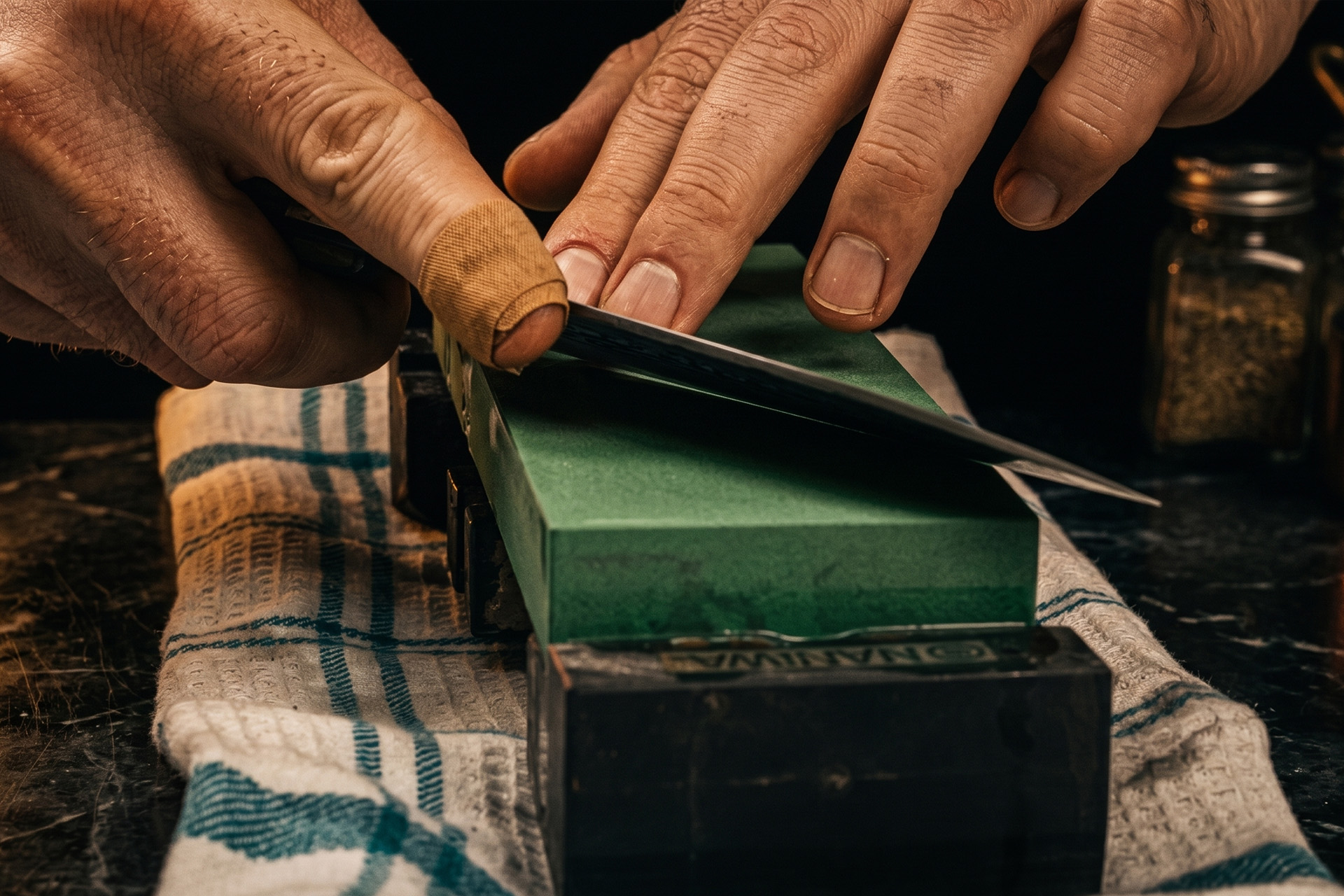
We see it in the shop all the time. Someone picks up a whetstone, picks it up, turns it over, and then puts it back down with the same sentence every time. “I would love to, but I would never be able to use it.”
We understand the hesitation. A stone can look like it demands a skill you either have or you do not, and that impression puts a lot of people off before they begin. But it is not an accurate one, and it is worth correcting, because sharpening a good knife is far more approachable than most people expect. It is also one of the best things you can do for a blade you paid good money for. Here is why.
What a whetstone actually gives you
A whetstone gives you a level of control that makes it the ideal way to learn, and control is the whole point.
You set the angle yourself, which gives you the freedom to shape the edge that suits you and the way you cook. You decide how much metal comes off, so you remove only what the knife needs and no more, which means it lasts far longer. You abrade the steel cleanly, so the edge comes off the stone crisp and strong. And you can take that edge as far as you like, from a solid working sharpness for everyday cooking through to a genuinely refined, keen edge when you want it.
That range is what makes a whetstone worth owning. You decide where on the spectrum to land depending on the knife and the task in front of you. A coarser finish leaves a slightly toothy edge that grips and pulls through dense vegetables. A finer, more polished finish glides through raw proteins and slices herbs cleanly without bruising them. Neither is better than the other in the abstract; they simply suit different jobs, and a stone lets you choose between them. For a quality knife, and a Japanese knife in particular, that flexibility is exactly what the blade was designed to reward.
There is a safety benefit too, and it is a real one. A sharp knife is a safer knife than a dull one. A dull blade needs force and slides off food when it slips, which is how most kitchen injuries happen. A sharp edge goes where you put it and stays there.
It is more approachable than it looks
Here is the honest position on the skill itself. Yes, there is a learning curve, as there is with anything worth doing. Your first attempt will feel a little awkward, and your first edge will not be flawless. That is normal, and it is nothing to worry about.
The important thing is that you do not need a flawless edge to succeed. As long as you understand the basic principle of what you are doing, your very first sharpened knife will already be noticeably sharper than it was before, often by a wide margin. You are not chasing perfection on day one. You are chasing better, and better is easy to reach. The finesse comes gradually, with practice, over time. There is no rush, because the knife improves at every stage along the way.
Think of it the way you would think of learning an instrument. Nobody plays a piece cleanly on their first evening, but they can play something recognisable very quickly, and it sounds better every week after that. Sharpening works the same way, with one difference in your favour: even a beginner’s early efforts leave you with a genuinely sharper, more useful knife straight away. Sharpening a good knife is, in truth, relatively straightforward. The fear of it is almost always larger than the reality.
The steel you own makes a real difference
Something many people never realise is that how easy or hard a knife is to sharpen depends enormously on the steel it is made from. As a rule, a good knife is far easier to sharpen than a poor one.
Take Shirogami, or White Steel, a classic Japanese carbon steel. Among chefs and knife makers it is known as one of the easiest steels there is to sharpen. It responds quickly on a whetstone and comes back to a keen edge in minutes rather than a long session, even on a basic stone. That ease is not incidental. It is one of the main reasons people choose the steel in the first place. So if you own a knife in a steel like Shirogami, you already own something prized specifically for how well it takes an edge. Learning to sharpen it means getting the full benefit of what you bought.
Good stainless steels behave well too. Modern Japanese stainless takes a fine edge and sharpens predictably on a stone. The broader point is that quality steel, properly made and properly hardened, is a pleasure to work with.
A cheap knife is a different story. The kind you might pick up for two or three hundred rand is usually made from low grade steel with poor or minimal heat treatment, and that combination is genuinely difficult to sharpen well. Heat treatment is the careful heating and cooling process that gives steel its proper hardness, and it is one of the first things a cheap manufacturer cuts corners on. The result is steel too soft to take or hold a real edge. It grinds away readily enough, but it will not come to a crisp point, it raises a stubborn ragged burr that is hard to remove, and whatever edge you do manage to form rolls or crumbles almost immediately. People often learn on a knife like this, get a frustrating result, and conclude that the fault is theirs. It usually is not. It is the knife.
This is the part worth holding onto. A good knife is not harder to sharpen than a cheap one; it is easier, and it holds the edge once you get there. If you have invested in a quality blade, sharpening it is far less of a battle than you might fear.
You do not have to figure it out alone
One thing has changed the picture completely: help is now everywhere. There are thousands of free videos that walk through every step in close up and slow motion, alongside written guides and active communities of people who enjoy helping a beginner reach their first proper edge. Whatever you are unsure about, someone has already explained it clearly, and for free.
You can also come to us. Bring your knife and your stone into Hyde Park Corner or the V&A Waterfront and we will happily set you on the right track. If you would rather be shown in person than learn from a screen, we run sharpening lessons designed to take you from unsure to confident with an experienced sharpener beside you. You never have to teach yourself from scratch unless that is what you prefer.
Think of it as protecting your investment
Here is the way we would frame it. If you are willing to spend three, four, or five thousand rand on a knife, then learning to look after that knife is one of the soundest investments you can make. As we have seen, a knife at that level is usually made from steel chosen partly for how well it sharpens, so you are working with the blade rather than against it. Kept properly sharp, a good knife will serve you well for decades. Left dull and neglected, that same knife is a waste of what you paid for it. A stone and the skill to use it cost very little next to the knife itself, and they protect it for its entire life.
You bought a proper tool. Learning to maintain it is simply part of owning one.
And if it is not for you, that is completely fine
We will be straight about this too. Not everyone wants to learn to sharpen, and there is nothing wrong with that. You might not have the time or the inclination, which is entirely understandable and does not make you any less of a cook.
That is exactly why we offer a professional sharpening service. Bring your knives in to either store and we will return them to a proper edge for you, done properly, by people who do it every day. Whether you would rather learn the skill yourself or simply leave it to us, your knives get the care they deserve either way.
Curious about your first stone, or would you rather have your knives sharpened by us? Come and see us at Hyde Park Corner or the V&A Waterfront, book a sharpening lesson, or ask us about our sharpening service. We are always happy to help.
FREE KNIFE SHARPENING GUIDE BELOW: