


Why Does My Knife Go Dull?

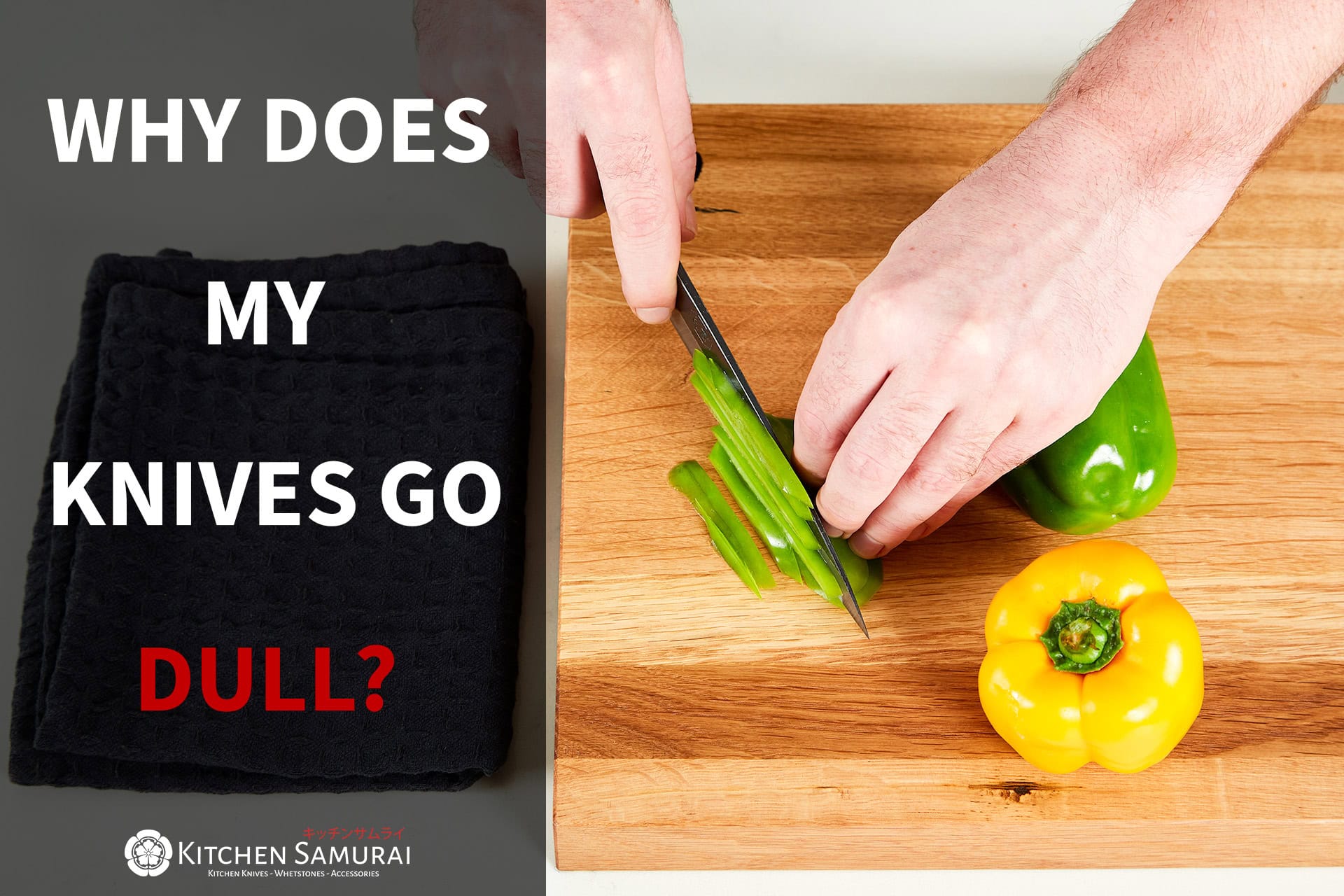
It’s not just about how often you use it. Steel choice, heat treatment, your cutting board, blade geometry, and daily habits all play a role. Here’s what’s actually happening to your edge and what you can do about it.
It Starts with the Steel, But Not the Way You Think
When most people ask why their knife has gone dull, the first assumption is that the steel must be low quality. And while the type of steel absolutely matters, it’s only one part of a more complex picture. Understanding how steel contributes to edge retention requires looking beyond the name stamped on the blade.
Kitchen knife steels broadly fall into three categories: high-carbon steels (like Shirogami and Aogami), stainless steels (like VG-10 and Ginsan), and powdered metallurgy steels (like SG2/R2, HAP40, and ZDP-189). Each category brings a different balance of hardness, toughness, wear resistance, and corrosion resistance. High-carbon steels can be honed to an exceptionally keen edge and tend to sharpen beautifully, but they react to moisture and acids. Stainless steels resist corrosion but can be more difficult to sharpen and may not reach the same peak sharpness. Powdered steels are made by atomising molten alloy into a fine powder and pressing it under extreme pressure. They combine high hardness with a fine, uniform carbide structure, offering remarkable edge retention in the hands of a skilled maker.
But here’s what many people miss: two knives forged from the exact same steel can perform dramatically differently. The reason is heat treatment.
Why Heat Treatment Is the Soul of the Blade
Heat treatment, known as netsushori in Japanese, is the process that transforms raw steel into a functional blade. It involves carefully controlled heating, quenching (rapid cooling), and tempering (reheating at lower temperatures) to alter the steel’s internal microstructure. The goal is to convert the steel into a hardened martensitic state while retaining enough toughness to resist chipping and fracture in real-world use.
Get it right, and you have a blade with a fine, uniform grain structure that takes a razor edge, holds it through service, and sharpens predictably on a whetstone. Get it wrong, and even a premium steel like Aogami Super or SG2 will chip prematurely, roll its edge under moderate use, or refuse to sharpen cleanly.
Each steel alloy has an optimal hardness window. VG-10, for example, performs best when heat-treated to around 60 to 61 HRC. Pushed beyond that without careful process control, it becomes prone to chipping. Shirogami #1 can be taken up toward 64 to 65 HRC in the right hands, rewarding the user with exceptional edge retention and peak sharpness. But the difference between a Shirogami blade forged in Sakai by a master blacksmith and one mass-produced with a generic heat cycle can be night and day.
The Maker Matters
In Japanese bladesmithing, heat treatment techniques are often proprietary, refined over generations within a single workshop. The blacksmith’s control of quench timing, tempering temperatures, and even clay application thickness (in differential hardening) is what separates a good knife from an extraordinary one. This is why two blades stamped with the same steel name can feel completely different on the board. When you’re choosing a knife, you’re not just choosing a steel. You’re choosing a maker’s mastery of that steel.
Hardness: A Balancing Act
Hardness, measured on the Rockwell C scale (HRC), tells you how resistant the steel is to deformation. Japanese kitchen knives typically range from 58 to 66 HRC, considerably harder than Western knives, which tend to sit between 54 and 58 HRC. A harder blade can be ground to a more acute edge and will resist the abrasive wear that dulls softer steels. But hardness comes at a cost: brittleness. The harder the steel, the less tolerant it is of lateral stress, impacts, and improper technique.
This is the fundamental trade-off in knife metallurgy. Toughness and edge retention are generally opposing properties, and it is very difficult to maximise both simultaneously. A steel with excellent wear resistance (lots of hard carbides in the matrix) might chip if the edge angle is too acute. A very tough, low-alloy steel might roll its edge before it ever chips, requiring frequent touch-ups on a honing rod or strop. The ideal knife finds the right balance for its intended purpose.
Geometry: The Invisible Performance Factor
A knife’s geometry, meaning the cross-sectional profile from spine to edge, has a profound impact on both cutting performance and edge retention. Yet it’s the factor most people overlook entirely. Two knives with the same steel and hardness will feel completely different if one is ground thin behind the edge and the other is left thick.
The key measurement is thickness behind the edge, which refers to the steel width roughly 1 to 2mm above the cutting apex. A blade that is thin behind the edge parts food with less resistance, requires less force per cut, and places less stress on the edge itself. A blade that is thick behind the edge may feel dull even when the apex is sharp, because the wedge of steel following the edge forces food apart rather than slicing through it.
Edge angle matters too. Japanese knives are typically sharpened to 12 to 15 degrees per side (24 to 30 degrees inclusive), compared to 18 to 22 degrees for Western knives. This more acute angle produces a sharper, more refined cut but creates a thinner, more delicate edge that demands better cutting habits, appropriate cutting surfaces, and regular maintenance.
Why Your Knife Feels Dull When It Isn’t
If your knife feels sharp at the very edge but wedges into dense vegetables like carrots or butternut, the issue isn’t sharpness. It’s geometry. The blade is too thick behind the edge. Sharpening only addresses the final few microns at the apex. Thinning the blade behind the edge (a process the Japanese call hamaguri or convex thinning) restores cutting performance across the entire profile. This is a service a skilled sharpener can provide.
◆
Your Cutting Board Is Dulling Your Knife
This is the single most common, and most easily fixable, reason knives go dull prematurely. Every time you complete a cut, the edge of your blade makes contact with the cutting surface beneath it. If that surface is harder than the steel at your blade’s apex, damage occurs. Every single time.
Glass, ceramic, granite, marble, and steel surfaces are all significantly harder than knife steel. Cutting on any of these materials will rapidly dull, chip, or roll even the best Japanese blade. Glass and ceramic are the worst offenders. They provide absolutely no give, and the blade impacts a surface that can be harder than the steel itself. It takes just a few cuts on a glass board to undo hours of careful whetstone work.
Bamboo is often marketed as an eco-friendly alternative, but it’s a poor choice for quality knives. Bamboo has a very high silica content, making it almost as abrasive as some ceramics. It will wear down a fine Japanese edge noticeably faster than wood or soft plastic.
Plastic (HDPE/polyethylene) is a reasonable option and is widely used in professional kitchens for hygiene reasons. It’s gentler than bamboo or glass, though it does scar over time. Deeply scored plastic boards become rougher and more abrasive with use, accelerating blade wear. Replace plastic boards when they become heavily scarred.
Wood is the best choice for preserving your edge. Specifically, end-grain wood boards, where the wood fibres point upward like a bundle of straws, are ideal. When your blade cuts down into end grain, the fibres separate and then close back together, cushioning the edge rather than resisting it. End-grain boards made from hinoki (Japanese cypress), maple, walnut, or cherry are all excellent options. Edge-grain boards (the more common flat-plank construction) are also good, though slightly less forgiving than end grain.
Soft rubber boards (such as the Asahi Hi-Soft, used widely by professional sushi chefs and competition cooks in Japan) are another outstanding option. They offer a stable, non-porous cutting surface that cushions the blade without scoring or releasing microplastics.
The Simple Rule
If you wouldn’t sharpen your knife on it, don’t cut on it. Your board should yield to the blade, not resist it. End-grain wood or soft rubber for everyday prep. Plastic for raw proteins if hygiene protocol demands it. Everything else (glass, stone, ceramic, steel, bamboo) is damaging your edge with every cut.
◆
Knife Maintenance: Habits That Protect the Edge
Understanding how knives actually go dull at a microscopic level helps explain why maintenance matters. There are four primary mechanisms of edge degradation:
Abrasive wear is the gradual grinding away of steel at the apex through friction with cutting surfaces and food. Even soft foods contain microscopic abrasive particles. Silica is naturally present in many fruits and vegetables. Over hundreds of cuts, these particles erode the edge geometry.
Edge rolling (plastic deformation) occurs when the thin apex of the blade folds over to one side under lateral stress. The knife isn’t chipped. The edge has simply bent. This is the most common form of dulling in everyday kitchen use, and it’s the type of damage that honing corrects. A few passes on a ceramic rod or leather strop straightens the rolled apex and restores cutting performance without removing steel.
Micro-chipping happens when the apex encounters a force that exceeds the steel’s toughness. Hitting a bone, a frozen surface, the edge of a plate, or an overly hard cutting board can all cause it. Small fragments of steel break away, leaving a jagged, dull edge that requires sharpening (not honing) to repair.
Corrosion is the chemical enemy. Moisture, acidic foods (citrus, tomatoes, onions), and the harsh detergents in dishwashers all attack the edge. Corrosion at the apex changes the edge geometry and weakens the steel, making it more susceptible to rolling and chipping. Carbon steels are particularly vulnerable, but no steel is immune. Even stainless alloys will corrode if consistently exposed to moisture and acids.
Daily Habits That Make the Difference
Hand wash and dry immediately. This is non-negotiable. Wash your knife with warm water and a soft cloth, dry it thoroughly, and put it away. Never leave a knife sitting in a sink, soaking in water, or air-drying on a rack. Dishwashers are extremely damaging. The combination of high heat, caustic detergents, and physical contact with other utensils corrodes the blade and chips the edge.
Store properly. Loose cutlery drawers are one of the most common causes of edge damage. Blades collide with other utensils, other knives, or the drawer itself. Use a magnetic knife rack, a knife block, or individual blade guards (sayas) to protect the edge when the knife isn’t in use.
Use the right knife for the task. A gyuto or santoku is designed for vegetables, boneless proteins, and general prep. It is not a cleaver, not a bone knife, and not a can opener. Using a thin Japanese blade to hack through bones, frozen food, or hard squash invites chipping and fracture. Use a deba or a Western-style heavy chef’s knife for those jobs.
Let the blade do the work. Japanese knives are designed for smooth, fluid cutting motions: push cuts, pull cuts, and controlled rocking. Pressing straight down with force, twisting the blade laterally, or using a sawing motion all place unnecessary stress on the edge. If you need to apply significant downward pressure, the knife is either dull or wrong for the task.
Never scrape food with the edge. After chopping, it’s tempting to scoop food off the board using the sharp side of the blade. This drags the edge sideways across the board at a damaging angle. Use the spine of the knife, a bench scraper, or simply turn the blade over.
Honing vs. Sharpening
These are two different processes that serve different purposes, and confusing them is one of the most common mistakes in knife care.
Honing realigns a rolled edge. It does not remove steel (or removes only a negligible amount). A few light passes on a ceramic rod or a leather strop straighten the microscopic apex that has folded over during cutting. For most home cooks, a quick hone before or after each session will maintain cutting performance between sharpenings.
Sharpening removes steel to create a new edge. This is done on whetstones (typically progressing from a coarse grit around 1000 to a finishing grit of 3000 to 6000) and is necessary when honing no longer restores performance, meaning the edge has been worn down through abrasion or damaged by chipping. For a home cook using their knives regularly, sharpening every few months is typical. A professional cook working long shifts may need to sharpen weekly.
A Note on Japanese Knives and Honing Rods
Traditional grooved steel honing rods (the kind you see chefs flicking their knives against at speed) are designed for softer Western steels in the 54 to 58 HRC range. Using a grooved steel rod on a harder Japanese blade (60+ HRC) can chip the edge rather than realign it because the blade is harder than the rod. For Japanese knives, use a smooth ceramic honing rod or a leather strop instead. Better still, learn to maintain your edge on a fine-grit whetstone.
◆
Frequently Asked Questions
Why does my Japanese knife go dull faster than my old Western knife?
Japanese knives are typically ground to a much more acute angle (12 to 15° per side versus 18 to 22°) and hardened to a higher HRC. This produces a sharper edge that cuts with less effort, but the thinner geometry is less tolerant of hard cutting boards, lateral stress, and impact. It’s not that the knife is inferior. It’s that it rewards (and demands) better cutting habits and surface choices.
Can a knife go dull just sitting in a drawer?
Yes, though slowly. Carbon steels can develop microscopic oxidation at the very apex of the edge, altering its geometry. Contact with other utensils in a loose drawer causes nicks and chips. Even stainless steels can experience minor surface corrosion at the edge over time. Proper storage in a saya, on a magnetic rack, or in a lined block prevents this.
Does cutting acidic food dull my knife?
It can, particularly with carbon steels. Acids from citrus, tomatoes, and onions react with the steel and can corrode the edge at a microscopic level. The practical solution is simple: wipe the blade with a damp cloth during extended prep with acidic ingredients, and wash and dry the knife promptly when you’re done.
How often should I sharpen my Japanese kitchen knife?
For a home cook, sharpening on whetstones every two to four months is typical, depending on how frequently you cook and what you’re cutting. Hone with a ceramic rod or strop between sharpenings to maintain the edge day to day. If you’re unsure, the tomato test never lies: if the blade doesn’t glide through a ripe tomato skin with its own weight, it’s time.
Is a more expensive knife harder to keep sharp?
Not necessarily. A well-made knife with proper heat treatment and good geometry is actually easier to maintain because it responds predictably to honing and sharpening. The investment is in the maker’s skill, particularly their heat treatment, which determines how the steel behaves over its lifetime.
◆ Easter Egg: Get 15% off your entire cart with code KS15EASTEREGG at checkout, limited to the first 5 customers, excludes already discounted items, valid until March 6th.
USE: KS15EASTEREGG at Checkout.
Every knife will eventually lose its edge. That’s not a flaw. It’s physics. But how quickly it dulls, how gracefully it degrades, and how effortlessly it comes back to life is determined by the steel, the maker who forged it, the board you cut on, and the habits you keep.
Respect the blade. It will return the favour.
Kitchen Samurai · kitchensamurai.co.za